Lost in the Stone Stories of Nizwa
You know what? I never expected an old fortress to move me like this. Walking through Nizwa, every carved door, sun-warmed wall, and quiet alley felt alive. This isn’t just architecture—it’s memory etched in stone. If you're craving a place where history breathes through its buildings, you gotta check this out. Nestled between rugged mountains and lush date groves in the heart of Oman, Nizwa is not a destination that shouts for attention. It doesn’t dazzle with neon or skyscrapers. Instead, it draws you in with stillness, with texture, with the quiet confidence of a town that has stood for centuries without needing to prove itself. Here, the past isn’t preserved behind glass—it lives in the way the wind moves through ancient towers, how sunlight falls across courtyard stones, and how the voices of vendors rise from a market that has echoed with commerce for generations. This is a journey into the soul of Omani heritage, where every structure tells a story, and every step feels like a conversation with time.
Entering the Heart of Oman: First Impressions of Nizwa
Reaching Nizwa is part of the experience—a winding drive through the Al Hajar Mountains, where ochre cliffs rise like sentinels and the air grows cooler with elevation. As the road descends into the interior plains, the landscape shifts from barren rock to vibrant green, fed by ancient irrigation channels known as aflaj. These UNESCO-recognized systems have sustained agriculture in this arid region for over a thousand years, channeling mountain runoff to nourish date palms, pomegranate trees, and small family farms. The transition feels symbolic: from isolation to abundance, from wilderness to civilization.
Nizwa, once the capital of Oman’s interior and a historic center of religious scholarship and tribal governance, greets visitors with understated dignity. Unlike the modern skylines of Muscat or Dubai, Nizwa does not seek to impress with scale or spectacle. Its charm lies in its authenticity. There are no luxury malls or high-rise hotels crowding the skyline. Instead, low-rise buildings with flat roofs and thick stone walls blend seamlessly into the terrain. The town hums with daily life—children walking home from school in crisp white uniforms, elders sipping tea outside corner shops, the occasional donkey cart moving slowly through side streets.
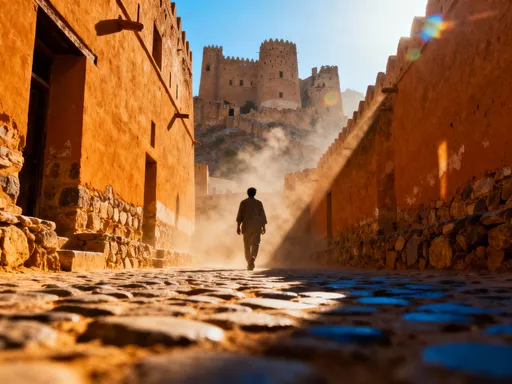
The first landmark that captures the eye is Nizwa Fort, rising from the flat expanse like a stone sentinel. Its massive circular tower, built from locally quarried limestone and sun-dried mud brick, dominates the skyline without overwhelming it. This is not a fortress designed for show, but for function—a stronghold that protected rulers, stored grain, and served as a place of refuge during tribal conflicts. As you approach, the scent of frankincense drifts from a nearby shop, mingling with the dry desert air and the faint aroma of roasting coffee beans. Time here doesn’t feel rushed. It unfolds, deliberate and deep, like the layers of history embedded in the walls around you.
Nizwa Fort: Where Power and Precision Meet
Nizwa Fort is more than a relic—it is a masterpiece of defensive engineering and environmental adaptation. Originally constructed in the 17th century under the rule of Imam Sultan bin Saif, the fort was designed not only to withstand attack but to support life in the harsh Omani climate. Its most striking feature is the massive cylindrical tower, 45 meters high and 40 meters in diameter, which served both as a watchtower and a residence for the ruling imam. The tower’s sheer size and smooth, sloping walls made it nearly impossible to scale, while its elevated position provided panoramic views of the surrounding plains and mountains.
What truly sets the fort apart is the intelligence woven into its design. The thick limestone walls, some over two meters wide, keep interiors cool during the day and warm at night. Clever ventilation shafts—vertical channels built into the walls—create natural airflow, drawing in cooler air from below and expelling hot air above. These passive cooling techniques, developed centuries before modern air conditioning, speak to a deep understanding of desert living. Even the fort’s acoustics were engineered with purpose: a whisper spoken at the base of the tower can be clearly heard at the top, allowing guards to communicate silently across levels.
Inside, the fort unfolds like a labyrinth. Narrow, spiraling staircases lead upward through storage rooms, prayer chambers, and guard posts. Hidden trapdoors in the floors once allowed defenders to pour boiling date syrup or hot sand on intruders—a brutal but effective deterrent. Water cisterns, carved deep into the foundation, stored precious rainfall for months at a time. The fort wasn’t just a military structure; it was a self-sustaining microcosm, capable of supporting life during prolonged sieges. Today, restored walkways and informative displays guide visitors through its chambers, but the sense of awe remains. You don’t just see the fort—you feel it, in the coolness of the stone, the echo of footsteps, and the weight of centuries.
The Old City: A Maze of Time-Worn Beauty
Just beyond the shadow of the fort lies the historic district of Nizwa, a network of narrow alleys and traditional Omani homes that seem to grow organically from the earth. These houses, built from stone, mud brick, and timber, are not museum pieces—they are lived-in, cared for, and passed down through generations. Their whitewashed walls glow in the sunlight, while intricately carved wooden doors stand as silent testaments to the craftsmanship of Omani artisans. Each door tells a story: the depth of its carvings, the height of its threshold, and the strength of its iron studs once signaled the status and wealth of the family within.
One of the most remarkable features of these homes is the badgheer, or wind tower—a pre-modern air conditioning system that captures cool breezes from above and channels them down into living spaces. These slender towers, often topped with latticed openings, are perfectly aligned with the prevailing winds. As air moves through the tower and into the house, it creates a natural draft that lowers indoor temperatures by several degrees, a crucial comfort in a region where summer temperatures can exceed 40°C. The design is both elegant and efficient, a reminder that sustainability was not a modern concept in Oman, but a necessity woven into daily life.
Walking through the old city feels like moving through a living archive. Laundry hangs from wooden balconies, cats nap in shaded doorways, and the occasional neighbor greets you with a quiet “marhaban” (welcome). There are no crowds, no loudspeakers, no souvenir stalls selling mass-produced trinkets. Instead, life unfolds at its own pace. Children play in courtyards, elders sit in the shade discussing the day’s news, and the scent of cardamom coffee drifts from open windows. This is not a reconstructed heritage site—it is a community that has preserved its identity not through forced conservation, but through continuity.
The Souq: Commerce Carved in Tradition
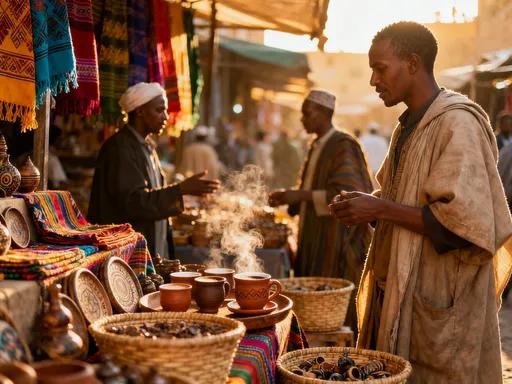
If the fort and old city speak of defense and domestic life, the Nizwa Souq is where culture, craftsmanship, and commerce converge. Unlike tourist-oriented markets in other Gulf cities, this is a working souq—first and foremost a place where locals shop, trade, and socialize. The covered market stretches along shaded walkways supported by stone columns and low arches, creating a rhythm of light and shadow that softens the desert sun. The air is rich with scent: dried limes, cumin, saffron, and the smoky aroma of frankincense resin burning in small brass burners.
Vendors sit behind wooden counters piled high with goods—bundles of dried herbs, stacks of dates in woven palm baskets, and trays of silver jewelry handcrafted by local artisans. One of the most iconic items on display is the khanjar, the traditional Omani dagger worn as part of national dress. These are not decorative replicas but functional works of art, forged from steel and inlaid with silver patterns that reflect the wearer’s region and heritage. Watching a craftsman hammer a blade into shape, his rhythm steady and precise, is to witness a tradition that has changed little in centuries.
The souq’s architecture supports its function. The covered walkways provide shelter from the sun while allowing airflow, and the compact layout encourages interaction. Bargaining is polite and unhurried—more a ritual of connection than a transaction. You might start by asking about the origin of a spice, and end up sharing a cup of tea with the vendor. The market is busiest on Fridays, after morning prayers, when farmers from surrounding villages bring fresh produce, honey, and goat cheese. It’s a place where economy and community are inseparable, where buying bread is as much about trust as it is about price.
Mosques and Madrasas: Spirituality in Stone
In a town shaped by faith and scholarship, religious architecture holds a place of quiet reverence. The Friday Mosque of Nizwa, one of the oldest in Oman, stands near the base of the fort, its simple dome and whitewashed walls blending into the surrounding buildings. Unlike grand mosques in other Islamic capitals, it does not seek to overwhelm. Instead, it invites reflection. The courtyard is open to the sky, with shaded arcades on all sides providing space for worshippers to gather before and after prayer. The prayer hall features minimal decoration—geometric patterns carved into stone, wooden beams stained dark with age, and a mihrab (prayer niche) oriented precisely toward Mecca.
What stands out is the sense of peace that permeates the space. There are no loudspeakers blaring announcements, no crowds jostling for position. The design emphasizes serenity—light filters gently through high windows, the floor is cool underfoot, and the only sounds are the rustle of pages and the occasional whisper. This is architecture in service of stillness, built not for display but for devotion.
Nearby, the ruins of ancient madrasas—religious schools—hint at Nizwa’s role as a center of Islamic learning. These structures, some dating back to the 12th century, were once filled with students studying theology, astronomy, and law. Their classrooms opened onto central courtyards, allowing light and air to circulate while fostering a sense of communal study. Though many are now in partial ruin, their foundations and archways remain, standing as silent witnesses to a time when knowledge was passed down in shaded cloisters. Today, new generations continue this legacy in modern schools, but the old stones remind us that education has long been a pillar of Omani society.
Modern Preservation: Keeping the Past Alive
Nizwa is not frozen in time. It is a living town, evolving while honoring its roots. In recent decades, the Omani government, in collaboration with local communities, has launched careful restoration projects to preserve the fort, souq, and old city. What makes these efforts remarkable is their commitment to authenticity. Repairs are done using traditional materials—limestone, mud mortar, and hand-carved wood—rather than modern concrete or steel. Artisans trained in ancestral techniques are employed to restore doors, windows, and decorative elements, ensuring that the town’s character remains intact.
Local guides, many of whom were born and raised in Nizwa, play a vital role in sharing its story. Their tours are not scripted performances but personal narratives—grandchildren of farmers describing how aflaj systems sustained their ancestors, or former blacksmiths explaining the symbolism behind khanjar designs. This intimate connection to place transforms a simple walk into a meaningful encounter. Museums within the fort and souq further deepen understanding, with exhibits on Omani history, traditional dress, and architectural methods. One display, for example, shows how mud bricks are made using a mixture of clay, straw, and water, then left to dry in the sun—a technique unchanged for centuries.
Even as modern amenities reach the town—paved roads, reliable electricity, internet access—there is a conscious effort to integrate them without disrupting the historic fabric. Solar panels are discreetly installed on rooftops, and new buildings in the surrounding area follow traditional design principles. This balance between progress and preservation is not always easy, but in Nizwa, it feels natural. The past is not something to be escaped or replicated—it is a foundation, a source of strength and identity.
Why Nizwa’s Architecture Stays With You
What makes Nizwa unforgettable is not merely its beauty, but its intentionality. Every arch, every door, every wind tower was built with a purpose—protection, comfort, worship, trade. There is no wasted detail, no ornament for ornament’s sake. This is architecture born of necessity, refined by time, and sustained by community. In a world where buildings are often designed for speed and profit, Nizwa stands as a quiet rebuke—a reminder that structures can be both functional and soulful.
Walking through its streets, you begin to understand that heritage is not just about preserving old things. It is about carrying forward a way of thinking—a respect for materials, a sensitivity to climate, a belief in craftsmanship and continuity. The people of Nizwa have not turned their town into a stage set for tourists. They live in it, care for it, and pass it on. That authenticity is what resonates long after you’ve left—the sense that you’ve touched something real, something enduring.
In a time of rapid change, Nizwa offers a different rhythm. It invites you to slow down, to notice the grain of wood in a carved door, to listen to the echo in a stone tower, to feel the coolness of a courtyard at noon. It reminds us that history is not only written in books, but built into walls, carried in traditions, and lived in everyday moments. To visit Nizwa is not just to see a place—it is to remember what it means to belong to a place. And that is a story worth carrying home.